Tuesday, March 4, 2014

Stare Bene vs. the Pursuit of Happiness

In Italy, when someone asks you, how are you? Come stai? It's a sincere question, how do you stay? Are you well?  I've seen Italians that I ask this pause, tilt their head and give me a look, like, wow, thank you for asking and caring how I'm staying.  In America, it's more of a greeting.  It's another kind of "Hello" or acknowledgement of your presence rather than a sincere inquiry on your status.  Whether you're having a good or bad day, typically the person asking, your co-workers, classmates, and the check out clerk at Walgreens, isn't sincerely interested on a full, in-depth analysis. He or she is just being friendly. 

And on top of that, how often do you stop to reflect on how you are?  Once a day? Once a week? Unless you make time for it, it's easy to not think about it and just stay focused on juggling various priorities which yields the shallow answer of fine, great, or good, thanks.

In Italy, staying well is something important.  With your friends or significant others, staying well with them is what's important.   Staying well alone with yourself is also important if not moreso. Ligabue sings about it in "Eri bellissima": "stai bene li con te?" "Are you well with yourself there?"  
And staying well with yourself through changes and new experiences is also important. One of my students explained to me that before studying abroad in America 20-some odd years ago, he broke up with his then girlfriend of 4 years because he wanted to be alone while embarking on this experience. To have the freedom and the space to change and grow personally.  He realized what was best for him and did it.

This idea of staying well with yourself lends to this external acknowledgement and objectivity of looking at the self.  I feel like Italians are able to step outside of themselves, not take themselves too seriously, and be self-aware.  One student described to me how he suffered as a child, and he was very matter of fact about it.   It's like an external, 360 degree analysis of self with acceptance.  That's how it is.  They're also able to step out and say, it's not a good moment in my life right now.  You would never say that in America.  People would look down on you because A-you're struggling, B-you showed weakness.

In America, what's important is doing well and being happy. Being happy with yourself, with your significant other, and with your job.  That's the goal.  I think the seeds for this present-day cultural goal of happiness were sown by Founding Father, Thomas Jefferson, when he declared that the pursuit of happiness as a right in the Declaration of Independence.  

But honestly, Tom, is this a destination that can be reached? And then what? Live happily ever after? For forever with no problems? Life is filled with never ending sorrows and joys. What about staying well?

Ultimately, pursuing happiness is a unachievable goal.  Happiness, however, can be found in the pursuit of goals. Perhaps a balanced update to this part of the Declaration would be the right to life, liberty, and the pursuit of goals while staying well.  Because what is reaching our goals without having stayed well?

Friday, February 21, 2014

Blues Brothers and Italy

February 21, 2014

Growing up in Chicago, you know the know the film, Blues Brothers. At least, that's how it was for me.  It was staple of my childhood.  My dad, my brother, and I would quote lines from the film.  I was a Blues Brother for Halloween when I was 12 years old.  It was a source of cultural pride.  The film shows some fantastic parts of Chicago, what it means to be a Chicagoan and from the Midwest.  At least, partially, what it means.  I had the film memorized.  

When I got my first apartment in Chicago, I was especially thrilled that my bathroom window overlooked the el (at the Paulina Brown line stop), just like the apartment in Blues Brothers, but just not as noisy.  At that time, I was working at a law firm and regularly went to the Daley Plaza, City Hall, and the County Building, all seen at the end of the film, to file, certify, and retrieve documents.  And later while working in radio sales, I often used Lower Wacker Drive to enter or exit the city.  (And movie aside, going to the Billy Goat, which Belushi and Aykroyd made famous with their Cheeseburger, Cheeseburger, no Coke, Pepsi SNL sketch, is a place you go to once in a while.  I don't really like their burgers, nor the chips, but I love going there.  It's a beautiful, little hole in the wall.  I adore Second City, too, the improv club where those guys made their start.)

After being here in Milan for a about a year, I had moments of homesickness.  So, you know what film I watched, that made everything feel better and the world seem right again:  Blues Brothers.  

Well, there's some sort of Blues Brothers cult following here.  About a week after watching it, I saw the Rocky Horror Picture Show live for the first time.  The two hosts at the beginning were dressed as the Blues Brothers and came out to their theme music.  Then I slowly began noticing it more and more everywhere.  Blue Brothers were used in advertising signs for a terrible, yet super cheap gym.  And when I tell people that I'm from Chicago, a common response is, oh, like the Blues Brothers.  I smile and nod, yes, yes.  

But tonight clinched it for me.  Nearing the end of the lesson, my 10 year old student and I had just started playing Go Fish.  I asked him what music he wanted to listen to.  He said, Blues.  Then he said, Blues Brothers.  I was taken aback.  Then he said, Everybody Needs Somebody.  My jaw hit the floor.  I pulled it up on YouTube, and in no time we were watching it.  And he sang along!  We didn't finish Go Fish.  We ended up watching other scenes from the film, and I turned it into a receptive language task on the present continuous.  

Watch out, Chicago.  Italy loves the Blues Brothers, too.


Kisses, Dating, and I Love You in Italian

September 2013 

Dating in Italy is different. No one asks, "what are we?" There's no exclusivity conversation.  It's just assumed that after 2 months hanging out together, meeting each other's friends, that you are a couple.  The only time it's talked about, with the "will you go out with me?" is in middle school.  I like it; it sends a clear message through actions.  That harks back to the cliche, actions speak louder than words.

Baci are kisses which you greet your friends and family with.  It's 2 kisses:  1 on the left cheek first, then 1 on the right cheek.  The Spanish greet also with kisses, but they start on the right cheek then go to the left cheek.  The Dutch greet with 3 kisses, left, right, then left.  It gets confusing at times depending on who you are talking to and where you are.

Now, often, friends will conclude an email with "Baci"  or "Baci e abbracci" (Kisses and hugs).  This is the normal salutation just sent electronically.  But if you are romantically involved with someone, I am told that you conclude the email with "Un Bacione" (a big kiss) and if you concluded it with "Baci" the other party would be taken aback.  Baci?  Baci are what you give your aunt.  But later I've seen emails from friends concluded with "Un bacione" and I don't know what to think.  An "abbracione" is a big hug.

In America, we say, I love you, to friends, lovers, boyfriends/girlfriends, mothers, fathers, children, etc.  The context you say it within is understood, and it's just one phrase.  The Italian have complexity, delicate layers, like that can be found with the millefoglie pastry or lasagna.   I've heard different explanations.  "Ti voglio bene" is used often.  It means I care about you.  You say it to you family, close friends, and even boyfriend/girlfriend and husband/wife.  "Ti amo" is reserved for more romantic, intimate relationships, but I don't think it's used very often.  "Mi piachi tu" doesn't really work or maybe it's said when to express a desire to escalate the relationship.


Friday, September 13, 2013

Inno: Soccer Team Song

Each team in Italy has an official song, an inno, and the fans listen to it.  It's not like a university fight song; it's more like a pop song, almost. They listen to it in their cars driving around.  It's interesting.

Here's Milan's song:  "Milan, Milan"


While I'm an Interista, I'm not a fan musically of their inno, "C'รจ Solo Inter."  It sounds like a Michael Bolton song or background music for a Sports Utility Vehicle TV commercial.  Where are the hands swaying with lighters?  But in all earnestness, the inspiration of the song is cool.  Peppino Prisco was the Vice President of Inter from 1963-2001.  He was asked once about having served under 5 different Presidents of Inter.  His response was, "Well, I always sought to serve only Inter."  He loved his team.


Here's Naple's inno, "Napoli."


Thursday, September 12, 2013

Amami! (Love me!) What?


If you stream RTL 102.5, Italian radio, (their app is great, by the way; they have an all Italian music web radio channel plus others), you might have heard this rousing anthem sung by Emma, "Amami."  I first thought it was someone's name (something close to Amelie) and didn't pay much attention to it until I noticed some Italian gals singing the chorus with fervor. Then later, after seeing the title on 102.5's app while it was on-air, I thought, "Ah ha!" The light went on, as what happens in the second language acquisition process. "Ama" is the informal imperative of love, amare, and "mi" is the pronoun referring to me.

So the next question in my analytical mind on the tram to an English lesson, is this "love me" in the sense of a command? Like stand up, sit down, love me, jump, etc? Or is this the exasperation of a woman who is pouring herself out desperately to a man who's just not that into her? Or perhaps is it her seizing a timely opportunity with someone she's cared about for a while but has lacked the courage or the circumstance or right words to allow for her express herself, so one day she just blurts out, "Amami" as some kind of pent up release. (Reminiscent of the pent up release  in Sense & Sensibility near the end with Emma Thompson).

I also wondered if this would make a good song for teaching imperatives if i ever go back to the States and teach Italian.

I remember in 1996 when Evita came out on film starring Madonna. The soundtrack is incredible; I think I know every song by heart. It's one of those press and play albums. My reaction to one of the songs on the album, "You Must Love Me" was, "Huh, you're ordering this man to love you on your command? That's not how love works." It's a modal giving an obligation in one sense.  It was only after watching the film did I gain the understanding and better appreciate the context. Juan Peron's done all these nice things for Eva. She was a bastard daughter raised in poverty who was refused from attending her own father's funeral and shown many hardships. She then concludes about Peron, you've done all these nice things for me, and now, sick with cancer, you're still by my side, therefore you must love me.  
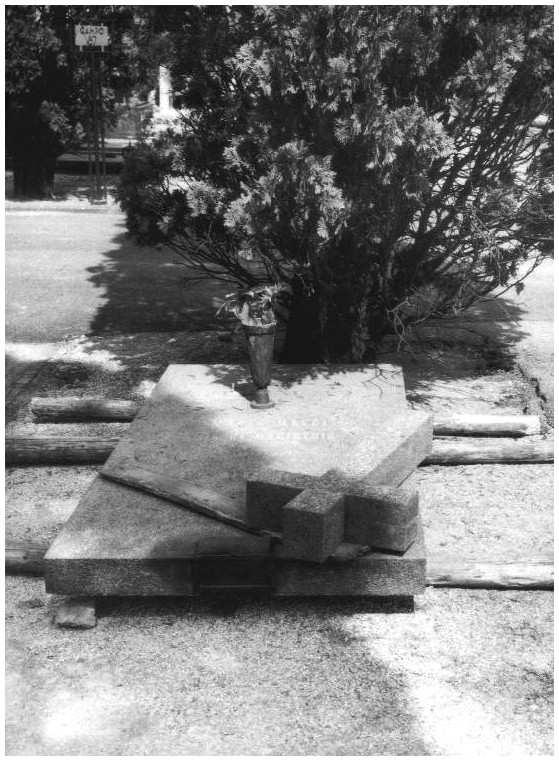
Eva's headstone under the false name.

A memorial marker placed in July 2005.
Incidentally, Eva's body was buried in Milan for a while. After the military coup removed Peron from power in 1955, they removed her body from display and kept it hidden in government offices. But somehow candles and flowers would turn up on it. So in 1957, they moved her body Cimitero Maggiore di Milano where she was buried under a false name, Maria Maggi de Magistris, and stayed for about 15 years.  Here's the  article from the BBC on Eva's post-mortem travels.

[And on another tangent, Eva died at the age of 33 from cervical cancer which is caused by an STD, HPV, which goes through condoms. She ought to be associated with the educational outreach for this disease.  80% of American women will have been infected by HPV by the age of 50. It's one of the slow growing cancers that can be caught with an annual pap smear. A distant relative of mine died from it later in life.  That's the challenge with this disease; it can't be caught if you don't get your annual pap smear. It doesn't matter if you've been married to the same guy for 10 years or are a widow in her 60s or 70s.  The end of my Public Health Service Announement.]

Language is fascinating and fluid in so many ways; context and nuance change everything. Imparami (learn me!) to its students, does it sing.

Update: September 12
Maybe the answer which I seek will be found after I translate the song and discover the context. :)  I think the song is love me is in the romantic sense of pour your love on me, lay all your love on me.  She talks about love me like the summer rain covers the earth, like a lighthouse sends light into the sea, etc.


Wednesday, May 8, 2013

Receding Waves in Cogoleto


The waves receding back into the sea in Cogoleto sound different compared to any other that I have heard before.  Like pachinko balls clinking together after winning a small pot.  Or several marbles colliding.  The sound made when you're when sipping out the last bit of soda.

The source of this sound:  the stones.  The beaches here are made of pebbles.  If you find any sand, it’s been imported. 

So when you visit Cogoleto, listen to the sound of the water rushing over the stones.  You're in for an auditory adventure.

Sunday, January 13, 2013

Everything I need to know in life I learned from Soccer


Anticipating others' moves.
Playing defense requires you to anticipate the moves of the offensive player so you can effectively stop him.   And you can’t play the ball---you’ll be tricked.  Every time.  Nor can you follow the player’s feet.  You have to watch the player’s hips.  Being aware of the other offensive players helps, but the goal is to defend the forward away from the goal towards the sidelines.  It’s being aware of their body language and anticipating their moves.  This is what helped me be a better driver.  You need to anticipate other drivers, especially when merging onto the Kennedy Expressway.  Are they accelerating, is there another car in front of them, does it seem like they might want to pass or switch lanes to get around, are they trying to exit the highway?  Then once you become familiar with the traffic patterns, you can anticipate the most frequented exits and moves other drivers will make.

Creating space.
This is important during the game to allow movement of the ball.  You can’t be standing still during the game.  Nor next to your teammate.  You have to get open—get square so they can pass the ball to you.  You have to know your strengths and weaknesses as well as those of your teammates so that you can play synergistically.  And ultimately, by creating space and passing, the balance of the power in the game changes.  I find this to be true in life with any kind of relationship.  You have to create space around yourself, to know yourself, to be able to handle yourself and, in turn, give space to those people so they can know themselves.  But at the same time, you move together be open with the goal of working synergistically.  There is no movement without space.  When someone is in your space, it stops your own personal movement and the movement of the team. 

Dirty Dancing.
Remember the scene in Dirty Dancing where Patrick Swayze is teaching Jennifer Gray how to dance?  He corrects her, maintain your space.  "Look spaghetti arms.  This is my dance space.  This is your dance space.  I don't go into yours.  You don't go into mine.  You gotta hold the frame."  Creating space and maintaining it is important in this game and dance of life.  It’s counter-intuitive—you think you want somebody in your life, that you have to go to them.  Don’t get me wrong; there are times you will have to go to that person, but there needs to be a balance.  The ebb and flow of life.  And by creating space, you are allowing things to enter your life.  Whether it’s getting rid of the clutter and maintaining a simpler and structured living environment, or eliminating draining relationships—a negative friend or a man who doesn’t want what you want.  How can you possibly grow, develop new interests, or meet new people if there isn’t any space for it?